
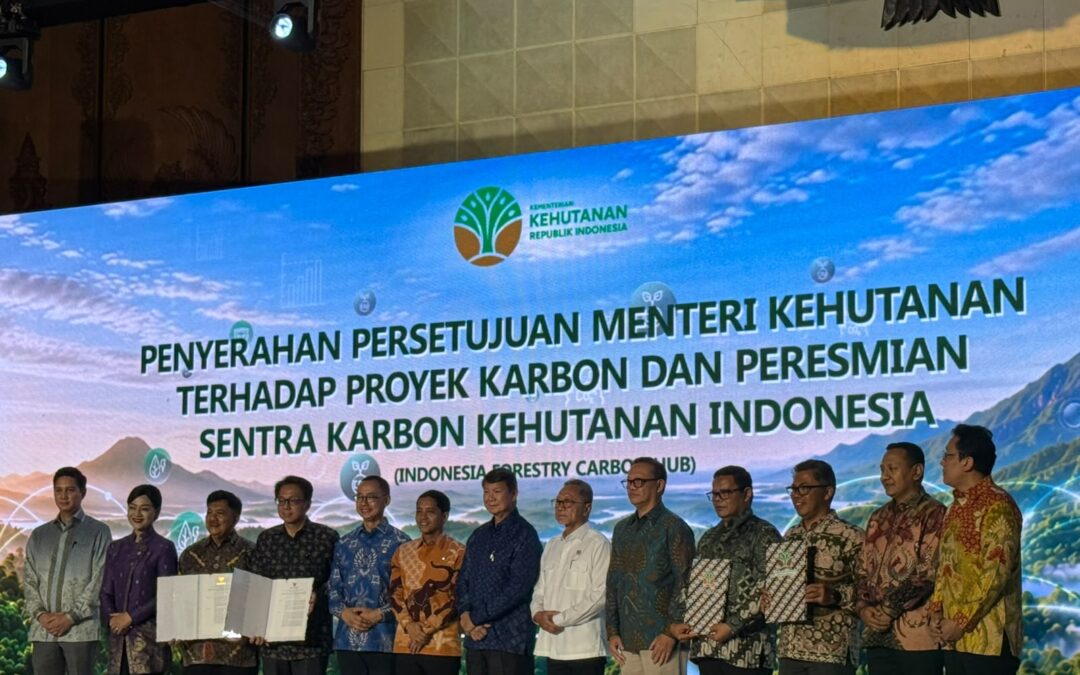
The Bujang Raba Landscape in Bungo Regency, Jambi Province, has reached another significant milestone in community-based forest management. During the official ceremony for the handover of the Minister of Forestry’s approvals for forestry carbon activities and the launch of the Indonesia Forestry Carbon Hub (IFCH), Bujang Raba officially received the Ministerial Decree approving the issuance of 238,281 tonnes of CO₂ equivalent (tCO₂e) of Non-SPE credits.
The decree was presented directly by Indonesia’s Minister of Forestry, Raja Juli Antoni, to Adi Junedi, Executive Director of KKI WARSI, representing the NGO that has facilitated the development of the Bujang Raba Community Carbon initiative. The ceremony took place in Jakarta on 6 July 2026.
The approval forms part of the Indonesian Government’s broader effort to strengthen national forestry carbon governance. During the same event, the Ministry of Forestry officially launched the Indonesia Forestry Carbon Hub (IFCH) as a collaborative platform bringing together government institutions, local communities, the private sector, academia, youth, and development partners to build a credible, transparent, and sustainable forestry carbon ecosystem.
The issuance of this approval marks an important milestone for Bujang Raba, as it formally integrates a community-based carbon initiative into Indonesia’s national carbon mechanism. Under this framework, emission reductions are recognized through Greenhouse Gas Emission Reduction Certificates (SPE-GRK), with all validation, verification, issuance, and registration processes integrated into Indonesia’s National Registry System for Climate Change Control (SRN PPI). This ensures that community-generated emission reductions are officially recorded within the national system and contribute directly to Indonesia’s climate commitments.
A Long Journey of Community Forest Stewardship
For KKI WARSI, this achievement is the result of decades of commitment rather than a short-term accomplishment. Long before carbon markets gained national attention, communities across the Bujang Raba Landscape had already chosen to protect their forests.
Working alongside KKI WARSI, government agencies, and various partners, local communities strengthened the governance of Village Forests (Hutan Desa), established strong local institutions, protected forest cover, and developed sustainable natural resource management systems.
The Bujang Raba Landscape encompasses 7,291 hectares of Village Forest managed collectively by five villages: Lubuk Beringin, Senamat Ulu, Buat, Laman Panjang, and Sungai Telang. Of this area, 5,336 hectares are designated as protection forests, while 1,955 hectares are sustainably managed for community use.
The well-preserved forests of Bujang Raba store an average of 287 tonnes of carbon per hectare, equivalent to approximately 1,087 tCO₂e per hectare.
Community commitment has also successfully reduced deforestation to zero during the 2013–2018 monitoring period. Although forest cover experienced some decline in 2019 due to increasing external pressures, the communities remained committed to maintaining at least 80 percent forest cover, a conservation target agreed upon when they first secured Village Forest management rights.
This achievement has been made possible by the strengthening of local governance institutions through the Village Forest Management Institutions (LPHDs). The five LPHDs have evolved into transparent, participatory, and accountable local organizations capable of managing forests sustainably.
Representatives from all five LPHDs attended the ceremony in Jakarta, representing the communities that have served as the frontline guardians of these forests for many years.
Bujang Raba as a National Learning Model
As part of the event, KKI WARSI Executive Director Adi Junedi was invited as one of the speakers in a national panel discussion highlighting the progress of forestry carbon initiatives across Indonesia.
During the discussion, the Bujang Raba experience was presented as a national example demonstrating how strengthening community forest tenure can simultaneously support forest conservation, emission reductions, community livelihoods, and green economic development.
Expressing appreciation to the Ministry of Forestry, Adi Junedi stated:
“We sincerely appreciate the Ministry of Forestry for issuing the approval for 238,281 tCO₂e of Non-SPE credits for the Bujang Raba Landscape. For us, this is far more than an administrative document. It is national recognition of the long journey taken by communities that chose to protect their forests despite continuous pressures to convert them. Behind these 238,281 tonnes of CO₂e are thousands of hectares of intact forests, protected watersheds, conserved biodiversity, and communities that have never stopped caring for their forests. We hope that Indonesia’s national carbon mechanism will provide equitable benefits for local communities as forest stewards while strengthening the country’s efforts to address climate change.”
Collaboration Is the Key
Minister of Forestry Raja Juli Antoni emphasized that the development of Indonesia’s forestry carbon ecosystem must be built through broad collaboration involving all stakeholders.
“The Indonesia Forestry Carbon Hub is designed as a shared platform for all stakeholders. Government, local communities, businesses, academia, young people, and development partners must work together to build a credible forestry carbon ecosystem. Through collaboration, we can not only ensure that forests remain protected but also guarantee that the economic benefits generated from carbon reach the communities who have long served as the true guardians of Indonesia’s forests.”
From Bujang Raba to Indonesia
The issuance of the Non-SPE Approval marks a new chapter for community-based carbon initiatives in Indonesia.
The experience of Bujang Raba demonstrates that effective climate solutions are not only created through national negotiations or international agreements but also emerge from rural communities that consistently choose to protect their forests.
Through secure community forest tenure, strong local institutions, sound forest governance, and unwavering conservation commitments, the people of Bujang Raba have shown that conservation, community well-being, and climate action can advance together.
Behind the 238,281 tCO₂e now entering Indonesia’s national carbon mechanism stand thousands of hectares of forests that remain intact because local communities continue to protect them. From Bujang Raba, Indonesia learns that the future of forest carbon is built not only through policy, but also through the determination of communities who safeguard forests every single day.
Implementation of Ministry of Forestry Regulation No. 6/2026
In addition to Bujang Raba, the Minister of Forestry also granted approvals to three Forest Utilization Business License (PBPH) holders and one Social Forestry initiative as forestry carbon project developers.
Together, these four initiatives are projected to generate approximately 31 million tCO₂e in Greenhouse Gas Emission Reduction Certificates (SPE-GRK).
The issuance of these approvals marks a major milestone in the implementation of Ministry of Forestry Regulation No. 6 of 2026, officially integrating forestry carbon into Indonesia’s national carbon trading ecosystem. Under this framework, verified emission reductions generated from forestry—including Social Forestry initiatives—can now be traded through government-recognized carbon market mechanisms.
The ceremony, held at the Manggala Wanabakti Building in Jakarta, was attended by Coordinating Minister for Food Affairs Zulkifli Hasan, Presidential Special Envoy for Climate and Energy Hashim Djojohadikusumo, senior representatives from national ministries and agencies, local governments, the private sector, academia, civil society organizations, and community forest managers from across Indonesia.