
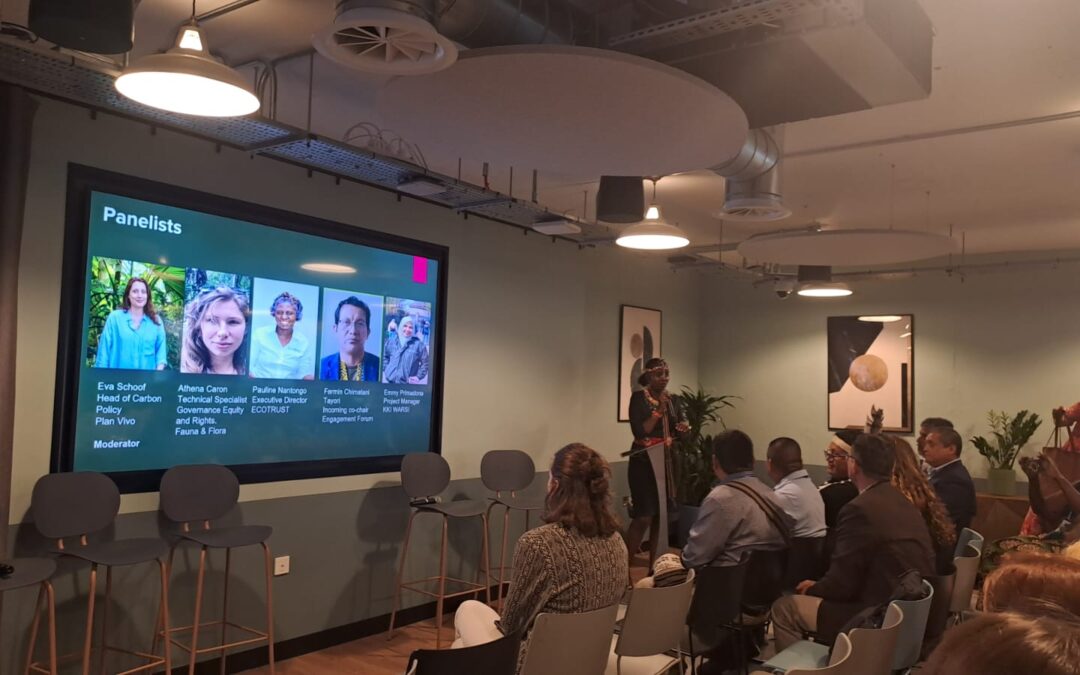
The experiences of communities in protecting forests and managing natural resources provide important lessons for developing a more inclusive and sustainable carbon market. This message was delivered by Emmy Primadona from KKI Warsi during the international forum “Launching the Forum Community of Practice: Gathering Insights and Building Alliances” as part of the London Climate Action Week in London.
The forum, hosted by Engagement Forum, Flora & Fauna, Plan Vivo, and LEVEL, brought together various actors within the carbon market ecosystem, including Indigenous Peoples and local community representatives, civil society organisations, project developers, standard-setters, carbon buyers, and investors.
 The event marked the public launch of the Community of Practice (CoP), a structured, community-centred learning platform designed to ensure that the knowledge, experiences, and leadership of Indigenous Peoples and local communities directly shape how carbon markets are governed, how standards are developed, and how carbon projects are designed and implemented.
Representing KKI Warsi’s experience as the Project Developer for the Community PES Bujang Raba, Emmy Primadona emphasized that community involvement in carbon projects should not be viewed merely as participation, social safeguards, or emission reduction mechanisms.
“For WARSI, CoP is not only a space for participation. It is at the core of ensuring long-term commitment, overall project success, improved community livelihoods, and the enabling conditions needed for the sustainability of every carbon project,” Emmy said.
She highlighted that carbon markets need to recognize communities as project leaders, rather than only as beneficiaries or implementers. Communities living alongside forests hold valuable knowledge, experience, and responsibility that determine the success and integrity of carbon initiatives.
“Every step taken by communities in protecting forests deserves recognition and appreciation. They are not only part of the project, but the key drivers who determine success on the ground,” she added.
KKI Warsi views one of the major challenges in the current development of carbon markets as the lack of a coherent and integrated system that fully incorporates community leadership into market mechanisms.
This is where CoP plays a strategic role: creating a space where communities and carbon market actors can engage in open dialogue, share experiences, and develop solutions through collective learning.
Through the Community of Practice, stakeholders are not only discussing communities, but learning together with communities. The platform promotes practical exchange, honest conversations, and collective learning to ensure that community perspectives move from the margins of carbon market governance to its centre.
During the discussion, Emmy also highlighted several key actions that project developers need to take to support the CoP principles.
First, project developers must create meaningful spaces for communities to participate in decision-making and become leaders within projects. Understanding community needs, aspirations, and local knowledge is essential for long-term success.
Second, project developers need to actively participate in CoP and integrate lessons learned into project design and implementation, including standards and best practices developed collectively.
Third, developers have an important role as a bridge between communities and carbon markets, ensuring that community contributions are fairly recognized—not only economically, but also socially and ecologically.
Fourth, strengthening community capacity must become a priority, enabling communities to manage resources, participate in governance, and contribute to decision-making processes related to their forests.
For KKI Warsi, the experience of Community PES Bujang Raba demonstrates that forest protection and climate solutions can only succeed when communities are placed at the centre.
With a community-based approach, carbon markets can become more than an economic mechanism. They can become a pathway to strengthen forest protection, improve livelihoods, protect biodiversity, and ensure ecosystem sustainability.
“The transition towards a more equitable carbon market requires a shift in perspective. Communities must be recognized as partners and leaders, because they are the ones protecting forests every day,” Emmy concluded.